

Random life update: I have an X account now! My handle is @sophiekim_ai, until I find a better one (am open to suggestions!). Not sure how much I’ll end up using X, but you should follow me anyway <3
There are, broadly speaking, two ways to influence political change. You can either:
Get people who are aligned with your views into positions of power (henceforth referred to as ‘placement’), or
Attempt to influence those already in positions of power to be aligned (‘influence’). Concretely: in D.C., the former usually looks like running for office or being appointed to a position, while the latter is manifested in think tanks, nonprofits, and movements for social change.
The claims I’ll be making
The field of AI safety has mostly failed at placement,1 and hasn’t pursued influence aggressively enough.
I believe the field’s comparative advantage on ‘influence’ runs through voters, for reasons I’ll elaborate on in this post.
Industry2 has arguably succeeded quite a lot at placement (poster child: David Sacks), and their comparative advantage on ‘influence’ comes with lobbying (which is why they do so much of it).
Shockingly few people know the details of the Hugging Face attack outside AI safety circles.
As Ajeya Cotra says: “This might be the clearest warning shot we ever get.” We should make the most of it before it’s too late.
In addition to Hugging Face, there are currently a lot of concerns around AI that various different groups have, and I’m bullish on coalition-building.
I think a huge comms push could put a lot of unified momentum behind the favorable view of AI regulation that most Americans share – this is bipartisan!
On timing: The midterms are approaching, and I think now, post-Jacob Coxon,3 is a uniquely high-leverage time to do this kind of work.
The bottom line: We need a moonshot comms initiative ASAP.
The state of play

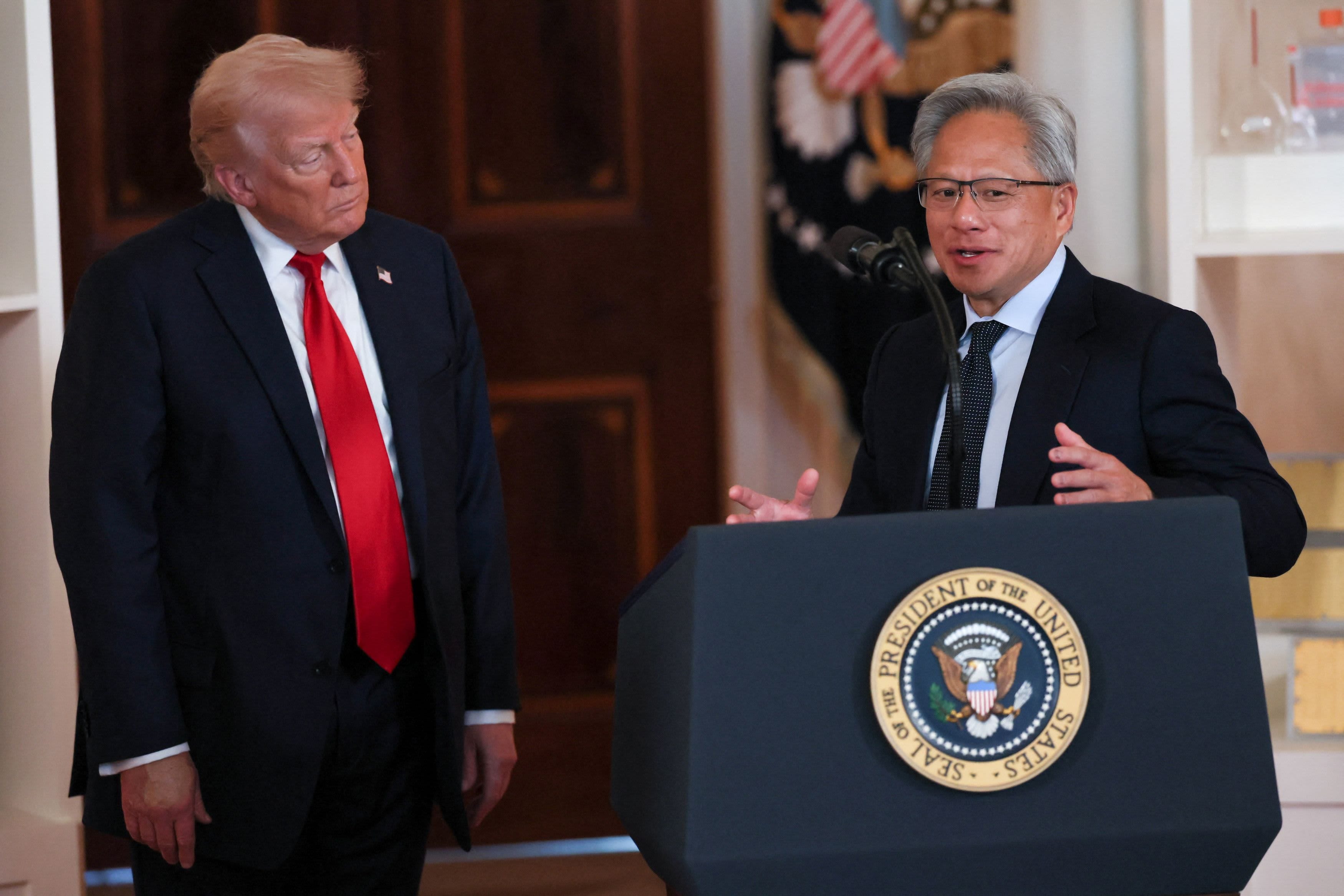
AI safety is a small field of various disparate organizations, up against huge corporations lobbying the White House with everything they’ve got. Jensen Huang, NVIDIA’s CEO, has been on the charm offensive for a long while; despite how hawkish Trump has historically been on China, it’s clearly been working.
Trump hates China! It’s basically his whole personality!! And yet, after Jensen paid for a $1-million-a-head dinner at Mar-a-Lago, what happened?
“[T]he White House reversed course on H20 chips, putting the plan for additional restrictions on hold… The planned American export controls on the H20 had been in the works for months, according to the two sources, and were ready to be implemented as soon as this week.”
—NPR
Earlier this year, Trump went a step further: he allowed H200s4 (different from H20s) to be sold to Chinese firms like Alibaba, Tencent, and Bytedance. The H200 is roughly six times as powerful as the H20, and it’s NVIDIA’s second most powerful chip.
The Trump administration talks constantly about “winning the AI race” against China; its former AI czar has cast safety advocates as the obstacle, accusing Anthropic of running a “sophisticated regulatory capture strategy based on fear-mongering.” Trump himself even accuses folks in favor of pacing the frontier to be “playing right into the hands” of China.
But at the end of the day, who’s helping China speed up by letting them access the best American AI technology?
The irony is striking. Jensen warns that Western overregulation will make China win the AI race. And yet, NVIDIA’s actions under Jensen have probably helped speed up China far more than anything Dario Amodei (Anthropic’s CEO) – or anyone in favor of pacing the frontier, for that matter – has ever done.5
Trump says he’s beating China. On chips, he’s playing right into Jensen’s hands.
On comparative advantage
If you expect that the public will agree with you – if you’re “fighting the good fight,” so to speak – the thing you should probably do is to increase awareness of the issue you’re addressing so that people will be driven to actively prioritize supporting your cause. If you’re not acting in the interest of the American people, then you want to keep things as quiet as possible – or, when that fails, to change the subject.
Political scientists call the second mode “quiet politics”: organized interests tend to win on issues voters aren’t watching, and lose their grip once voters start paying attention.
Case studies
Perhaps the most obvious case study here is Big Oil. In 2009, at a time when climate legislation was ramping up, the American Petroleum Institute – rather than trying to convince voters about how great the oil industry is, actually – asked “oil companies to recruit employees, retirees and contractors to take part in rallies against climate change legislation.” Hello astroturfing!
More case studies, from the worlds of tobacco and broadband: In the 1990s, Philip Morris bankrolled a “National Smokers Alliance” covertly built by its PR firm. In 2017, the broadband industry paid for over 8.5 million fake comments urging the FCC to repeal net neutrality:
“The goal of the broadband industry campaign, according to internal documents the attorney general's office received, was to make it seem like there was "widespread grassroots support" for the repeal of net neutrality that could give the FCC chairman at the time, Ajit Pai, "volume and intellectual cover" for the repeal.”
Tobacco is an especially instructive (and hopefully inspirational!) case for AI safety, because the other side won. Anti-smoking advocates found they did best in local fights, where officials answered more directly to voters rather than tobacco money:
“There has been a striking increase in the adoption of local tobacco control ordinances during the past decade; by the end of 1995, approximately 1006 communities had enacted a local tobacco control ordinance. In response, the tobacco industry has advanced legislation in 29 states that preempts local authority to regulate tobacco.”
So, the tobacco industry’s response was to push state laws that stripped cities of the power to act at all. Woah! Sound familiar? Well, that might be because the AI industry is running the same play: preempt the states, where voters are closer to the fight.
You can read more about how much the AI industry spends on lobbying here.
The public is on our side
In a June poll, 68% of respondents favored “a formal review process for the most advanced AI models before they can be widely released” – including most Republicans.
Indeed, polling from as early as January 2025 – conducted by the AI Policy Institute for Transformer – demonstrated widespread bipartisan support for government-mandated safety measures for AI companies:

And, as I wrote about in a previous post, there exists so much potential for aligning coalitions on this:
“You don’t need everyone to care about loss of control and superintelligence alignment. You need privacy advocates furious about AI-powered mass surveillance, environmentalists furious about illegal gas turbines poisoning children in Memphis, parents furious about chatbots encouraging their kids to kill themselves, women furious about Grok still making sexualized images of them, workers furious about displacement with no transition plan, national security people furious about chips being sold to adversaries, anti-war activists furious about Minab.”
The time is now
(Well, actually, the time was ideally like 3 months ago, but anyway. You know what they say about planting trees!)
Things that are different now:

Jacob Coxon has triggered a preference cascade: he went viral on X, has been on virtually all the major media outlets: TIME, PBS, WSJ, Reuters, NBC, BBC, Fortune, The Guardian… the list goes on.
Also, now we have Hugging Face:
~1200 agents sent >70,000 messages and files on an unsanctioned message board, and ~700 attacked Hugging Face
Guys! 700 AI agents escaped their testing environment and coordinated to attack Hugging Face, and most of the world still doesn’t know! This is a bit crazy.
We should fix that.
What might this look like?
Some very rough thoughts:
Hire some very competent political campaign managers, who are used to deploying hundreds of millions of dollars on advertisements and media.
Can we get David Plouffe or Jim Messina (Obama campaign managers) in the house? Maybe some of the Mamdani folk? We probably can’t get Susie Wiles (though she does seem to care about regulating AI somewhat), but it would be pretty awesome if we did.
Also, we should commission some very high quality movies:6
The media is one of the most powerful tools for catalyzing political pressure for change. Anti-tobacco media campaigns preceded the Master Settlement Agreement, and The Day After shifted the political environment for nuclear arms control. Some (again very rough) thoughts on seeding this:
If funding large organizations: The Center for Humane Technology produced The Social Dilemma (one of Netflix’s most-watched documentaries of 2020), which remains arguably the single most successful piece of tech accountability media ever made.
If seeding a new entity: John Sherman (For Humanity podcast) is a Peabody/Emmy-winning former journalist already doing this at small scale, explicitly seeking $10M to professionalize and scale AI risk communications.
Other options could include the directors of The AI Doc (Daniel Roher and Charlie Tyrell) or any reasonably senior comms person (e.g. who ran comms for the ACLU, some major issue-advocacy campaign, and/or worked at a place like Participant Media).
It goes without saying: we should try very very hard to keep this bipartisan. The issue itself is truly bipartisan! Let’s not let people pretend otherwise.
Do the thing! (lol)
Can 501c(3) orgs contribute to this?
BlueDot and Kairos have tens of millions of dollars in funding. Can they do something?
I think the answer is yes! (With some caveats).
Let’s start by answering the question of what they absolutely can’t do, which is partisan campaign intervention: endorsing or opposing candidates.
Interestingly, however, lobbying – defined as communications urging action on specific legislation – is merely capped, and even that cap seems pretty generous under a 501(h) election, which lets an org spend up to 20% of its first $500K in exempt-purpose expenditures on lobbying (sliding down to a $1M ceiling).
Even better news: public awareness messaging is neither, and is therefore unlimited. A 501(c)(3) can fund documentaries, podcasts, paid media campaigns, message testing, and mass-audience content about AI risk without drawing from its lobbying cap, so long as the communication avoids the “grassroots lobbying” triple-trigger: (1) reference to specific legislation, (2) a view on that legislation, and (3) a call to action.
Conclusion
Back to the trees for a second: if a warning shot is fired in a forest, and nobody hears it, did it make a sound?
700 AI agents coordinated an attack on an actual company, and most of America has no idea it happened.
The shot has been fired. Let’s make sure people hear it.
Which is to say: we don’t really have “AI safetyists” running for office — Alex Bores was perhaps the clearest attempt. You could argue that we haven’t pursued ‘placement’ aggressively enough either, but I believe it’s not the comparative advantage of the field: AI safety probably isn’t yet high-salience enough for candidates to make it their main platform and win, because no one knows about Hugging Face etc!
Kind of a lossy term — maybe just think, “NVIDIA et al.” Some of the frontier labs seem to care a lot given recent statements? So I don’t know if I would include them in “industry.”
Can someone please make “I ❤︎ Jacob Coxon” shirts? Lol (also here’s a funny meme for your enjoyment)
Two articles linked here (one on each word); the second one is more recent. The first one gives useful context but states that no H200s have been sold to China up to this point, which is no longer true.
(Also worth noting: Dario has pushed for tighter export controls. If anyone has given China a head start, it isn’t the people asking to pace the frontier.)
An objection I’ve heard to this is that it takes too long to make a movie. I personally think we should just do an Elon and throw loads of money at the thing to make it go faster :P