I started writing this piece about 2-3 months ago, but was dealing with some personal things at the time that made it fall to the wayside for a lot longer than it should have. I’m returning to it now because I’ve been thinking about unconventional methods to pace the frontier (namely, that don’t route through the USG). Following the METR report and the AIFP timelines update, I am feeling pretty desperate.
Epistemic status: I do not usually work on middle powers research, so calibrate your expectations accordingly. I’d love for folks to point out where I may have gone wrong.
I am mostly posting this to pose an idea and start a conversation, rather than to deliver a confident take. I, too, am curious to know if this idea makes sense! And I am hoping that people wiser than I will comment all their criticisms, so that I can update accordingly.
(As the great AW says: “the optimal number of bad takes on your blog is not zero.” 😂)
Say the Dutch and/or German government decides that, “hey, the U.S. government isn’t doing enough to regulate AI, and we don’t appreciate these labs racing towards extinction.” Can they do something about it?
I think the answer is: Yes! But there are some caveats.
An overview of some claims I’ll be making in this piece:
ASML is dependent on the U.S. for many parts of its supply chain, which means ASML as a company stands to lose quite a lot if the Netherlands tries to use ASML as a political bargaining tool: there are few worlds in which, if the U.S. doesn’t cooperate, ASML can just sell their stuff to another actor to remain profitable.
ASML is the most valuable company in Europe; it is also the largest company in the Netherlands, and is the most popular investment held by Dutch households. This means the cost of the company failing would hit individual Dutch citizens.
In some number of positive futures, having ASML as a strategic asset could enable the Netherlands to fund Citizen’s Dividends (as described in AI 2040 – basically just UBI), making any attempts to leverage ASML additionally risky.
Germany might actually have stronger supply chain leverage over the U.S. than the Netherlands does, but the strongest version of exercising this leverage likely requires ASML and possibly even TSMC coordination, particularly in short-timelines worlds / depending on how long Germany waits before attempting to exercise said leverage (or, in other words, how close the U.S. is to AGI/ASI when Germany decides to act).
While Germany’s chip supply chain involvement represents a much smaller fraction of the country’s GDP relative to the Netherlands, German companies have more exposure to / involvement in the U.S. economy, which means the surface area for economic retaliation from the U.S. government is more substantial.
sole supplier of these opinions
A. Dutch Leverage
ASML assembles the lithography machines that chipmakers like TSMC and Samsung use to produce the advanced microchips that AI training runs on (NVIDIA’s GPUs fall into this category).
U.S. Supply Chain Dependency
Every ASML EUV machine depends on a light source that generates 13.5nm light, which the machine uses to pattern chips. These light sources bottlenecked EUV for a decade; China still cannot replicate them, and is likely not on track to for the next several years – according to a Diplomat article from July 2026, domestic Chinese sources currently produce 100–150 watts, compared to ASML’s 6001,000 watts (a recent breakthrough! Though most current machines are probably still closer to 600).
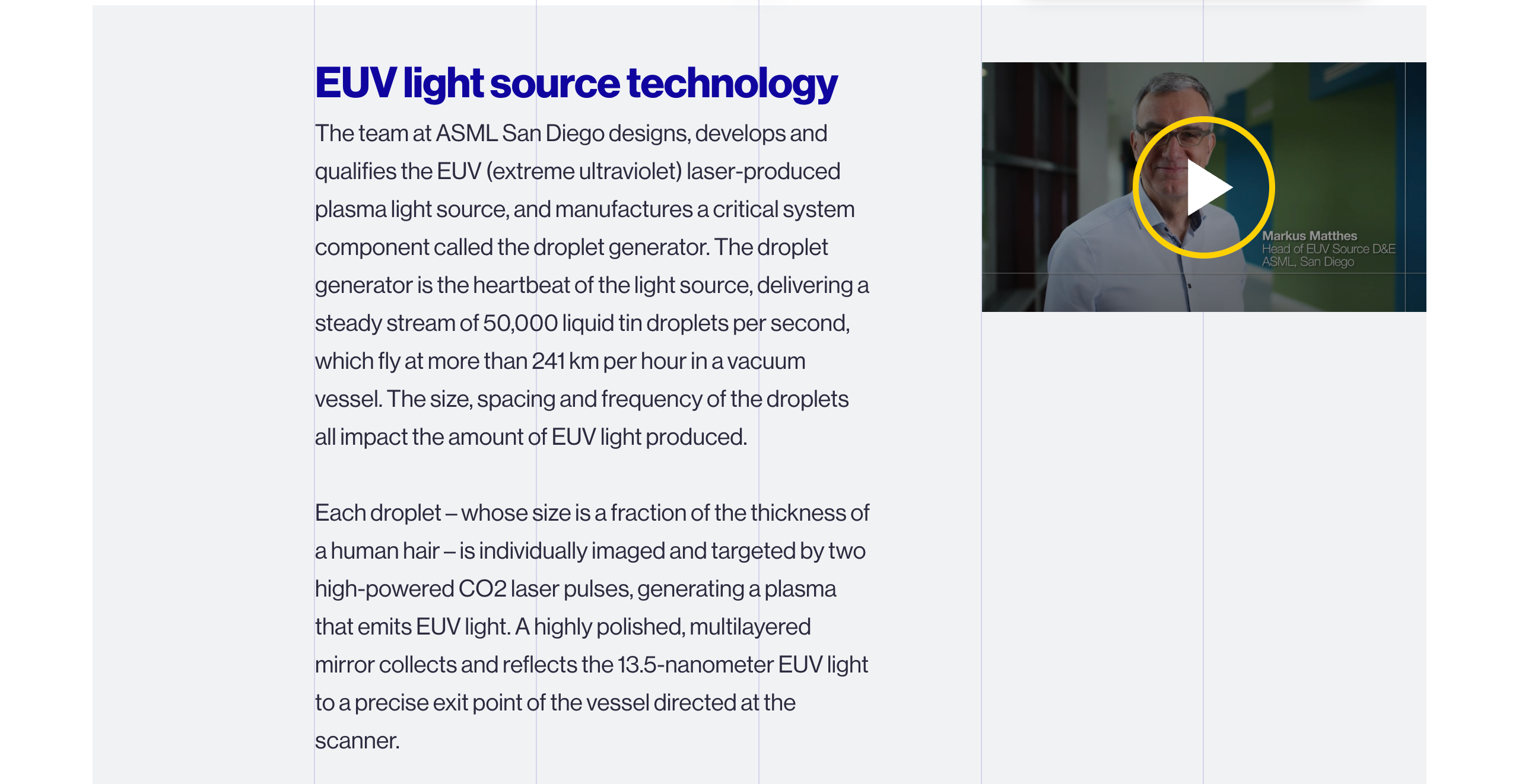
These EUV light sources are designed and developed in San Diego, by a subsidiary of ASML named Cymer that was acquired in 2013. ASML’s San Diego facilities also build droplet generators, which are consumables that wear out every few months, and that every installed EUV tool needs replaced on schedule.
(Note: Not every part of the light source is American, though. Trumpf, in Ditzingen, Germany, builds the drive laser, and it is the only company that does. The mirror that collects the light is German too – more on that below.)
“The team at ASML San Diego designs, develops and qualifies the EUV (extreme ultraviolet) laser-produced plasma light source, and manufactures a critical system component called the droplet generator. The droplet generator is the heartbeat of the light source, delivering a steady stream of 50,000 liquid tin droplets per second, which fly at more than 241 km per hour in a vacuum vessel.”
In addition to ASML’s San Diego site, they also have a site in Wilton, Connecticut, which is where “[they] test and assemble the lithography machine’s reticle handler and the reticle stage (the reticle contains the pattern to be printed on the wafer). Wilton is also one of [their] in-house optical fabrication sites.” This site has over 1,300 manufacturing employees.
ASML also runs a major R&D site in San Jose, home to the computational-lithography software it acquired with Brion Technologies in 2007. They describe the campus in a 2021 press release:
New cleanroom and lab space critical to prototype development
The new campus features a 24,000-square-foot state-of-the-art cleanroom and lab space, which will be critical for enabling the next generation of e-beam technology development as well as ongoing product improvements. This includes research in mechanical, optical and analog engineering, as well as testing, mechatronics and more.
Two consequences follow: first, in a sufficiently severe confrontation, the U.S. might attempt to seize San Diego and Wilton under emergency economic powers (flag: legal feasibility uncertain). That wouldn’t give the U.S. a working scanner, or even a complete light source, since the drive laser and the collector come from Germany. But it would take the droplet generator and the source engineering, and with it, would probably end ASML’s ability to build or service EUV tools for anyone. Second, U.S.-origin content may also give Washington jurisdiction over certain ASML exports under its de minimis rule, which means that even falling short of a confrontation where the USG forcefully seizes control of ASML facilities, they might still be able to exercise some amount of influence over who ASML can sell its products to.
So this dependency on the U.S. appears to somewhat weaken the position of the company. With that said, there are some reports that ASML has installed kill switches in their machines, particularly those that are in Taiwan. I don’t know the mechanics of how these work, but if true, this means that the Dutch might have serious leverage over existing EUV machines in Taiwan, and could e.g. threaten to disable machines as leverage in a negotiation.
Financial Risks & Effects on Dutch Citizens
I wrote the below ~a couple of months ago, analyzing what might happen if the price of ASML stock fell 25%. Two notes: First, because I started writing this so long ago, the below numbers are a bit outdated. Second, I think it is worth noting that since its June 30th, 2026 peak of $1,989.44 (which, to be clear, is not the one that the below analysis is based on), ASML has fallen to $1,507.85 as of November 10th, 2026 – about a 24% drop.
In November 2025, the most popular investment among Dutch households was ASML; in January, this reportedly changed, but ASML consistently ranks among the top two (I don’t have more recent figures on this beyond January, but I’d be very surprised if ASML is currently not #1 again).
So what would a 25% drop in ASML do? It would probably wipe out somewhere in the region of €3–4 billion of Dutch household wealth. Here’s a very rough breakdown of this estimate, based on three levels of exposure:
Household-owned stocks: From a Dutch article published in February 2026 (which I used Google Translate on): at the end of 2025, Dutch households owned about 4.2 billion euros’ worth of ASML shares.
This estimate is now somewhat outdated: ASML stock has increased in price since then.
On December 31st, ASML shares closed at €921.40. As of August 10th, 2026, ASML had increased 55% year to date (as of the time of writing, it’s probably even more).
4.2 billion euros*1.55 = 6.51 billion euros
So a 25% drop costs: 6.51 billion euros*0.25 = 1.6275 billion euros
Investment funds: Beyond directly held shares, Dutch households also own ASML indirectly through their €128.5 billion in investment funds. Most of that money sits in “global diversified equity funds” and bond funds, where ASML is under 1% of the portfolio; only a small slice is in Dutch-index funds. A rough estimate puts indirect ASML holdings at €1–2 billion, so a 25% fall would cost a further €0.3–0.5 billion – though I will flag that the exact split between fund types is not published in detail, so this number is pretty low confidence.
Pension funds: ABP, the largest Dutch fund, held about €1.4 billion of ASML at the end of March 2026 – just ~0.27% of its assets (going off of a reported ~524 billion euro total asset value from an article published in October 2025), less than it holds in Nvidia or Microsoft (ABP). Scaled across the roughly €1.7 trillion in Dutch pension assets, a reasonable estimate would be about €4–5 billion of ASML exposure system-wide (assuming ABP is at least somewhat representative), or roughly €1.1 billion lost at ‑25%.
Add the three channels, and you land at roughly €3–4 billion.
This only accounts for direct losses from an ASML crash! The more realistic situation is a downturn among all AI-related stocks – including all the hyperscalers, NVIDIA, SK Hynix, etc.
I won’t quantify those losses here because they’ll hit the global economy, and this analysis is mainly focused on effects if the Netherlands choose to exercise ASML leverage – but anything that hits the global economy will also hit the Netherlands.
B. German leverage
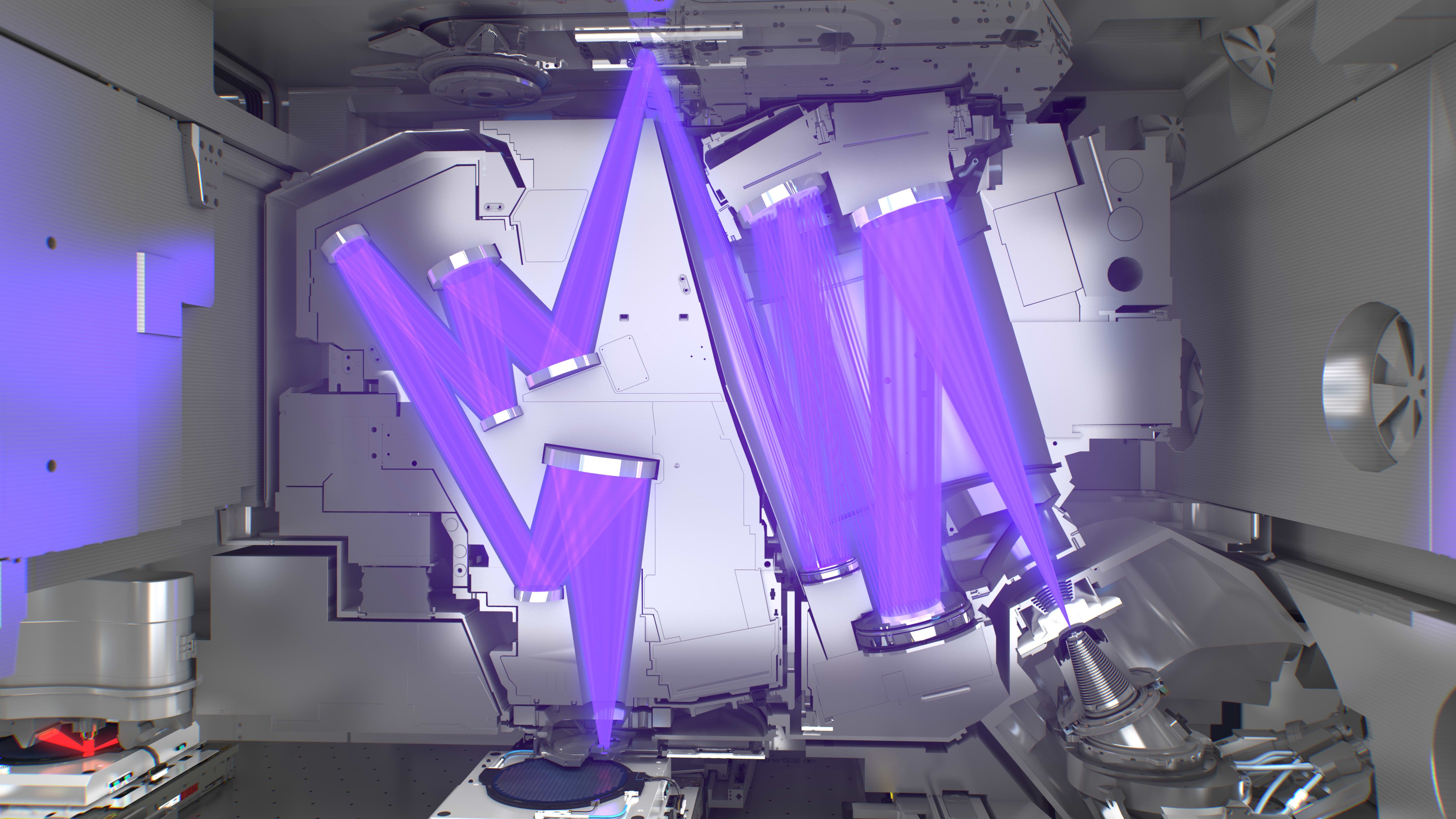
There’s a little-known1 company in Germany, named Carl Zeiss SMT, that is reportedly ASML’s “sole supplier of lenses, mirrors, illuminators, collectors, and other critical optical components.” Their relationship is described explicitly in ASML’s SEC filings.
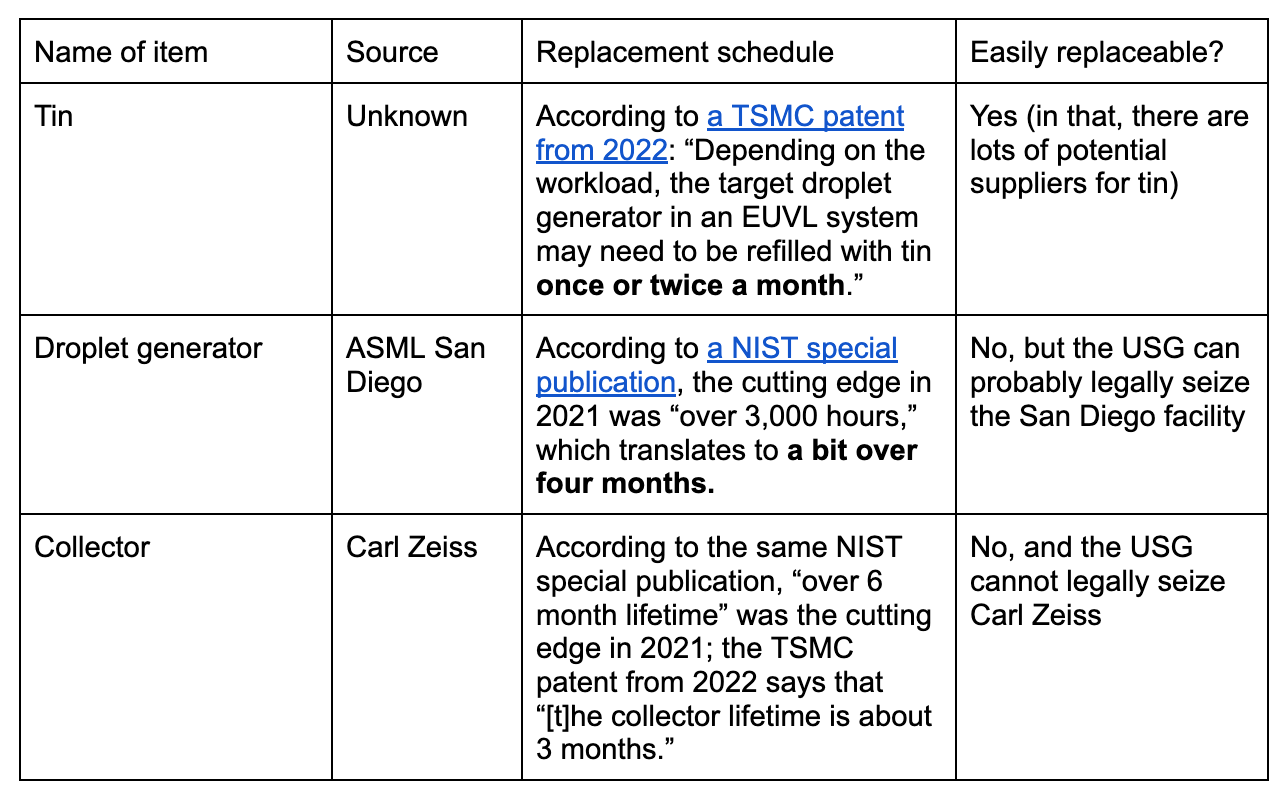
Collectors are the key component here, in that, of all the components that go into EUV machines that are (1) not produced in the U.S. and (2) not easily replaceable with a different supplier, they seem to wear out the fastest. While I don’t have numbers for 2026, “over 6 month lifetime” was apparently the cutting edge in 2021.
To elaborate on what I bolded above:
What are the inputs of an EUV machine that wear out the fastest?
Epistemic status: I asked Claude, and then took the top 3 from it (I stopped at the first entry that represented a meaningful point of leverage).
Big and important note: It’s very likely that since 2021/2022 these numbers have changed somewhat. I am not sure by how much they have changed, though, as I wasn’t able to find more recent figures.
If Carl Zeiss SMT stopped supplying collectors, it’s possible that every EUV tool could stop working eventually as parts wear out. (That said, given I’m operating off of what I expect to be now-outdated information, I don’t know whether current collector replacement rates make this an actionable chokepoint on relevant timelines.)
Two plausible things that could change this are (1)stockpiles and (2) possible refurbishment of parts (rather than replacement of them), which is why I wrote above that the strongest version of German leverage would probably require ASML and TSMC cooperation (or, if not the companies themselves, Dutch and Taiwanese government cooperation); there are likely spare parts stockpiles in facilities run by ASML and TSMC.
Why do I claim German leverage might be stronger than Dutch?
The two countries mostly sit on different chokepoints. ASML controls the growth of new EUV machines;2 Carl Zeiss controls a part it seems all existing machines can’t run without.
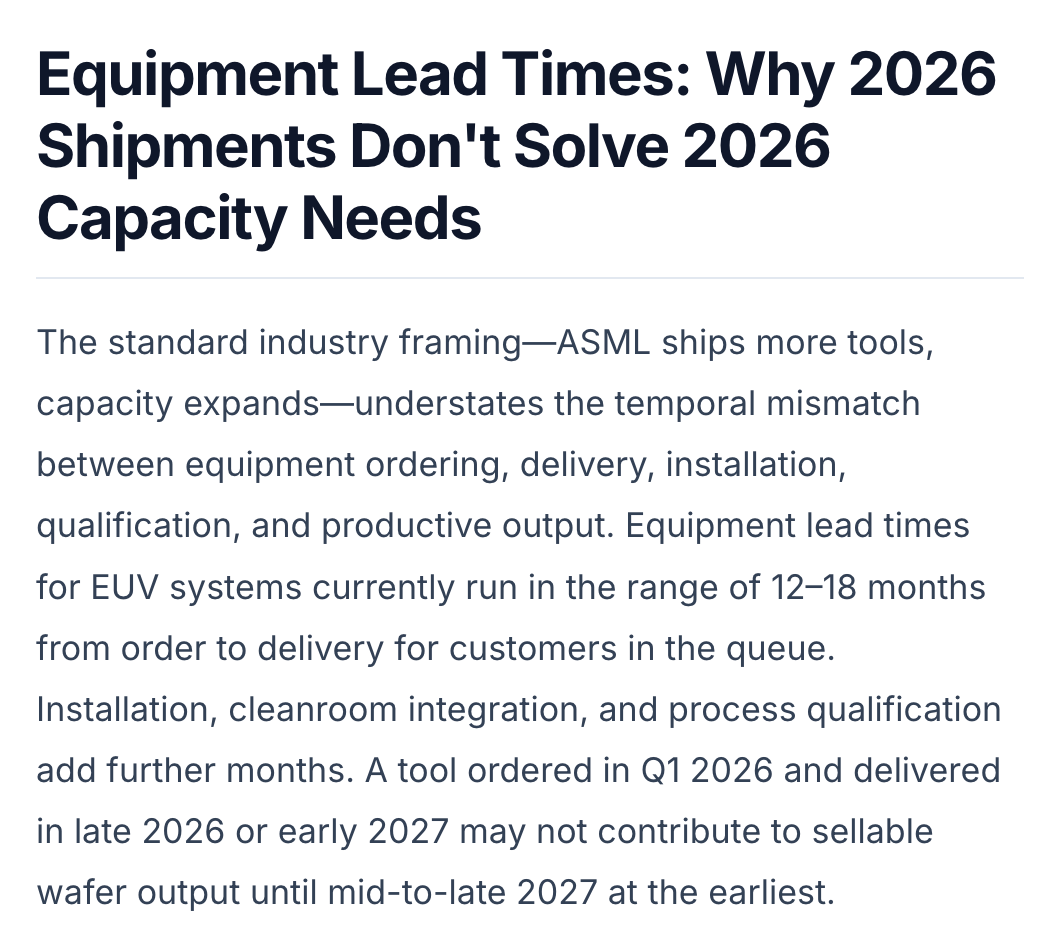
On the Dutch side: if the Netherlands blocked shipments tomorrow, every EUV machine already in a fab would keep running. What would disappear is the growth, i.e., the machines that would have been added. That still matters a lot, of course! But there are two reasons why it matters somewhat less in short timelines worlds: first, new machines come with some amount of lag – a scanner has to be installed and qualified before it prints wafers, and those wafers still have to be cut, packaged, built into servers, and installed in new datacenters.
Second, the increment is small compared to all existing EUV machines: TSMC alone ran an estimated 200 EUV machines towards the end of 2025; in 2026, ASML aimed to ship “over 60” new machines to customers worldwide.
A Dutch embargo caps the growth of compute, but it doesn’t shrink it.
To be fair, the Netherlands does still have some hold over all installed EUV machines, since ASML services them. But the fastest-wearing parts ASML makes itself – droplet generators – are built in California. (To address the obvious objection: Yes, it is possible that ASML could just refuse to cooperate if the U.S. tried to seize its San Diego facilities, and without their employees to run the facilities, the government may not be able to use them, but I have a lot of uncertainty on how this might unfold, so I don’t think I can comment on this very much.)
On the German side, the picture looks a bit cleaner: existing EUV machines need collectors, and Carl Zeiss can only make its optics “in Oberkochen and Wetzlar, Germany;” there is no San Diego equivalent for Washington to seize.
That said, another point in favor of stronger Dutch leverage would be if the size of the spare parts stockpiles for collectors was very big.
C. How might this work?
In my view, the version of Dutch/German supply chain leverage that is maximally likely to work requires three things to be true simultaneously:
(1) that execution is coordinated with whoever holds the spare-parts stockpile (hence why I mentioned possible TSMC coordination above);
(2) that labs, hyperscalers, chipmakers etc. will lobby Washington for a deal; and
(3) that the White House will actually listen to them.
The first seems hard to pull off without essentially giving the USG advance notice that something is afoot, the second seems reasonably likely, and the third may be largely dependent on unpredictable political headwinds.
Alternatively, both the Netherlands and Germany must be willing to accept substantial economic losses should they choose to exercise their leverage.
For both countries, the longer they wait to exercise any leverage ASML or Carl Zeiss might grant them, the less likely it is to be effective.
There are a few reasons I can think of for this:
The parts are only going to keep getting better, and thus, replacement timelines will lengthen. Carl Zeiss’s lever is effective because components of EUV machines wear out; every improvement on how long components last stretches the gap between a cutoff and the time at which it starts to matter. This also weakens the negotiating position of the Netherlands and Germany, because the U.S. can afford not to give in for longer.
The number of EUV machines that have been shipped and installed is only going to continue to increase. As I wrote earlier, a Dutch embargo would mostly cap growth, so each machine that ships before it weakens this effect.
Most importantly in short-timelines worlds: even when perfectly executed, this lever is slow. Machines run until their parts wear out, and spare parts stockpiles are exhausted. If that delay is longer than the time left before transformative AI, these actions will matter much less.
E. Conclusion
Ultimately, I wanted to post this mostly as a way to spark conversation, and to solicit takes from people wiser than me on such matters. It seems plausible to me that Dutch and German government lobbying could be a very reasonable, potentially high-leverage bet for AI safety to make right now. But there are a lot of complexities here that I feel I don’t know enough about to be able to say this confidently.3
I’ve enumerated some of these uncertainties in the 2nd footnote, but one worth putting in this article’s main text is how much a reduction in leading-edge chip production would actually slow frontier AI capabilities progress, given existing compute stockpiles, algorithmic improvements, and the time lag between chip manufacturing and deployment. I don’t have a confident answer to this.
What I do know is that there are a lot of middle powers that are growing increasingly worried about frontier AI, and U.S. labs’ seeming inability to stop models from, e.g., hacking into Australia’s healthcare system.
Rob Jetten, Prime Minister of the Netherlands, and Friedrich Merz, Federal Chancellor of Germany, both signed a statement in September 2026 titled “A Call for Control of Frontier AI Models.” It called for three primary measures:
Companies to develop transparent safety protocols, including mandatory pre-deployment testing and independent evaluation, with qualified evaluators granted sufficient access to assess risks.
Governments and regional organisations to further develop and coordinate common standards, strengthen transparency — including shared reporting of serious safety incidents — and ensure that countries across all regions have access to scientific capacity, expertise and trusted evaluation.
UN member states to build on existing international mechanisms and explore creating an international institution, able to set standards, enable verification, and convene states when capability thresholds are crossed.
It is not obvious to me that middle powers – particularly those with meaningful supply chain leverage – are limited to things like signing statements and trying to sort out things with the UN. I think there is a very reasonable chance that countries like the Netherlands and Germany could exercise more influence over frontier AI than they currently are, and that they might even be able to influence pacing.
The world, as SM says, is quickening. And lately it feels as though it has been quickening a whole lot.
We do not have time. We should start thinking more creatively about how to buy it.
subscribe before the singularity
If you are working on or thinking about something relevant to the above, feel free to contact me; I’m thinking about next steps in my career, and this is an area I am considering doing more work in.
Adding a caveat here for the kill switch thing, briefly discussed earlier. I’m mostly not focusing my analysis on it because I don’t know enough about how it works (there are very few details available online), but if it works well, ASML could hold a lot more leverage over current machines than this section suggests.
For example, this piece does not cover the legal mechanisms via which the Dutch or German governments could exercise influence over ASML and Carl Zeiss; I also don’t know anything about the spare parts stockpiles and where they’re located / how much stock is onsite at various chip fabs across the U.S. already, and how many additional months of EUV machine function these stockpiles could buy. I also don’t know enough about compute scaling to be able to guess what the effect of this would be on capabilities progress overall: would it be enough to slow SAR by some number of months?
I might write more on these sorts of topics in a future piece, depending on what feedback I get on this one.




Really appreciated this post! I'd heard mention of Zeiss before but didn't realize the extent of their leverage/singular supplier aspect.
Nice post! This seems like a much better researched position of my LW post here: https://www.lesswrong.com/posts/86NQZFN3SSAomboGv/the-eu-could-hold-ai-capabilities-development-hostage-if