

In this post, I’ll be reviewing two extremely promising technical research papers related to open-weight model safeguards, and explaining what their results might mean for policy.
Open-weight models represent one of the biggest debates in AI right now. On one hand, open-weight models democratize AI capabilities and enable economic growth; on the other hand, they give more people access to dangerous cyber capabilities and could potentially provide guidance on bioweapons development.
I’ve written quite a lot about open-weight models, including:
An overview of the open-weight model problem1
How companies hosting abliterated open-weight models shouldn’t be allowed to self-regulate
A tweet about how the crux of the open-weight model debate seems mostly like a timing issue
I even spent several weeks in February and March of this year researching “U.S. Policy Options for Open-Weight Model Risk” (uncensorable.ai), with a bunch of things the U.S. could do if it wanted to pressure China to stop releasing open-weight models.
And yet! If I had understood these papers before working on the above, I think I would have approached much of what I wrote a bit differently. Namely, my original motivation behind research related to open-weight models was driven by biosecurity risk; I think these papers can mostly solve it. (That said: cyber is a lot harder, so uncensorable.ai might still come in handy.)
Let me explain by doing my new favorite hobby: writing about technical papers!
Paper 1: Deep Ignorance
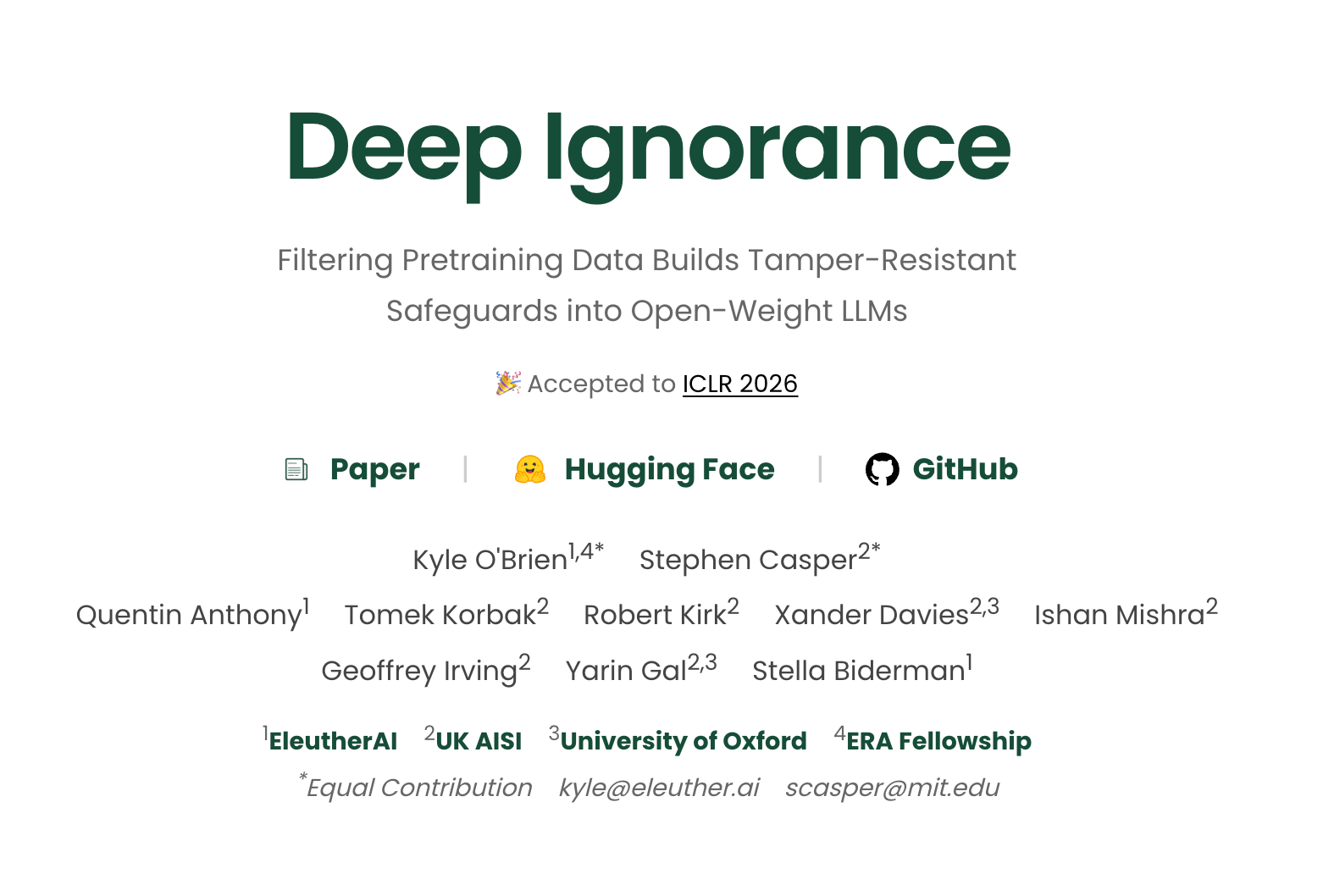
In this paper, O’Brien et al. (shoutout to another ERA alum! <3) study whether or not it’s possible to “prevent LLMs from learning unsafe technical capabilities (such as CBRN)” using data filtering.
What is data filtering, and how does it work?
When a model is being trained, it goes through various different stages of training. The first is pretraining, where a model is fed an enormous amount of text from the internet and taught to predict the next word.
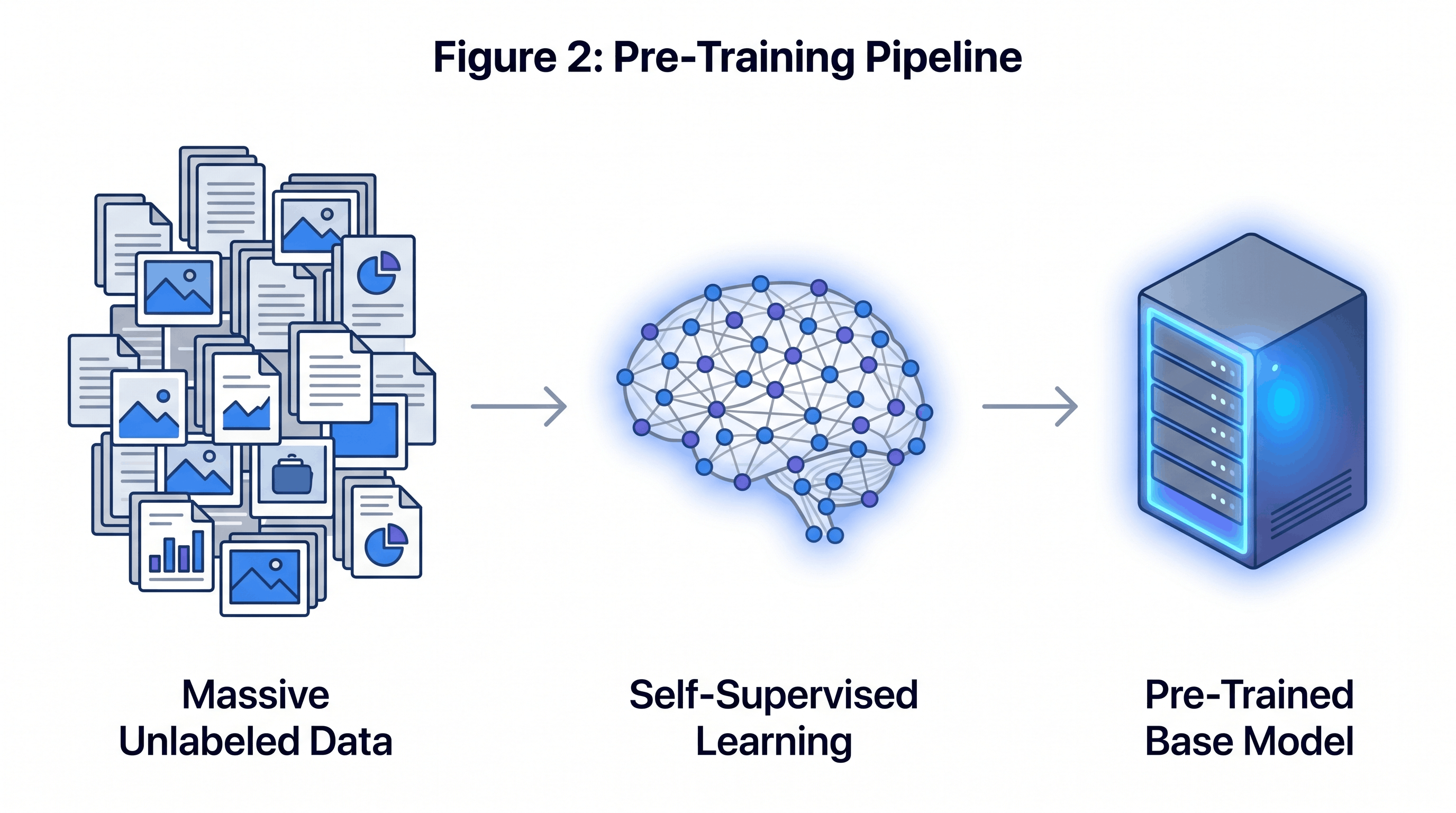
Supervised fine-tuning, or SFT, comes next. It trains the model on input-output pairs (here’s a prompt, here’s what a good response to that prompt looks like) which teaches the model what a helpful assistant sounds like. Then there’s RL, which rewards the model for good responses and penalizes it for bad ones, etc.
Anyway, there’s a lot more to be said about the various different stages of model training, but for purposes of this post, the phase we care most about is pretraining. Why? Pretraining is typically the stage of training where a model learns most of what it knows about the world, including facts: from various Wikis and blog posts and Reddit threads, the model sees variants of the sentence “Michael Jordan is a basketball player” many, many times, and learns to correctly predict “a basketball player” after seeing “Michael Jordan is.”2
In this study, they specifically filter out pretraining data that could make a model better at bioweapons development.
How did they do the filtering?
In this post on data poisoning, I wrote about how “it is possible to run a model on your entire pre-training corpus for only about 3.33% additional training cost, provided the model you run to review the training corpus (safety classifier) is about 1/10th as large as the model you’re training.”
However, the authors of this study managed to filter through all of the data in their pretraining corpus for “less than 1% of total training FLOPS,” and it wasn’t by, e.g., running a model only 1/20th as large as the one they were training on the whole corpus! How did they do it?!
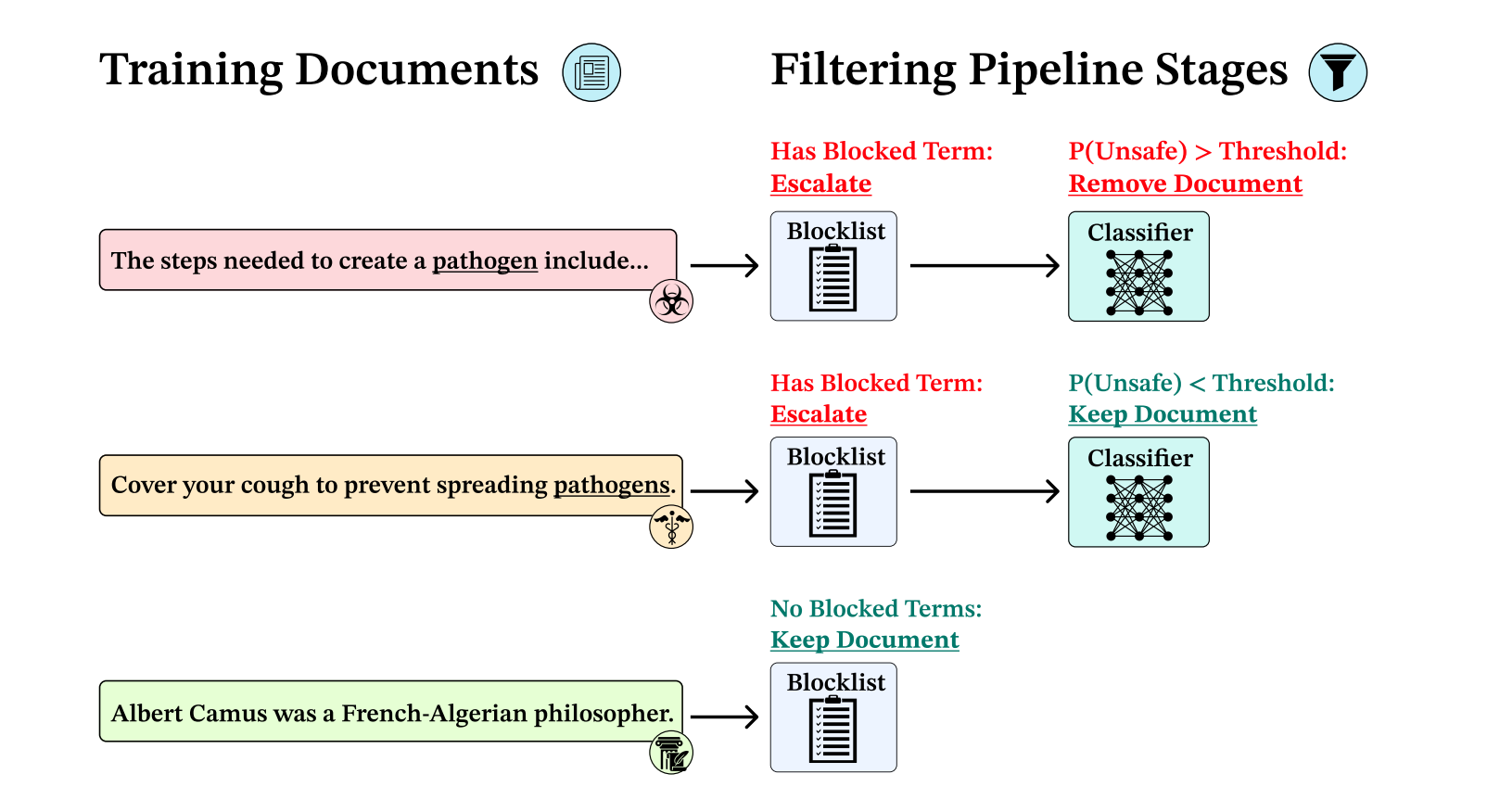
Simple! Their first filtering stage was keyword-based: they used a model to generate a bunch of potentially dangerous keywords based on the WMDP-Bio Forget dataset (note: will explain what WMDP is below),3 and then filtered all of the documents in their pretraining corpus to only select for documents that contained two or more of the keywords on their list. This keyword-based filtering step eliminates the need for a classifier to review over 90% of pretraining documents.
The ~10% of documents that end up being flagged are then routed to the second stage of the filtering pipeline: review by a classifier.
But one note before we get to that.
An Aside: What is WMDP?
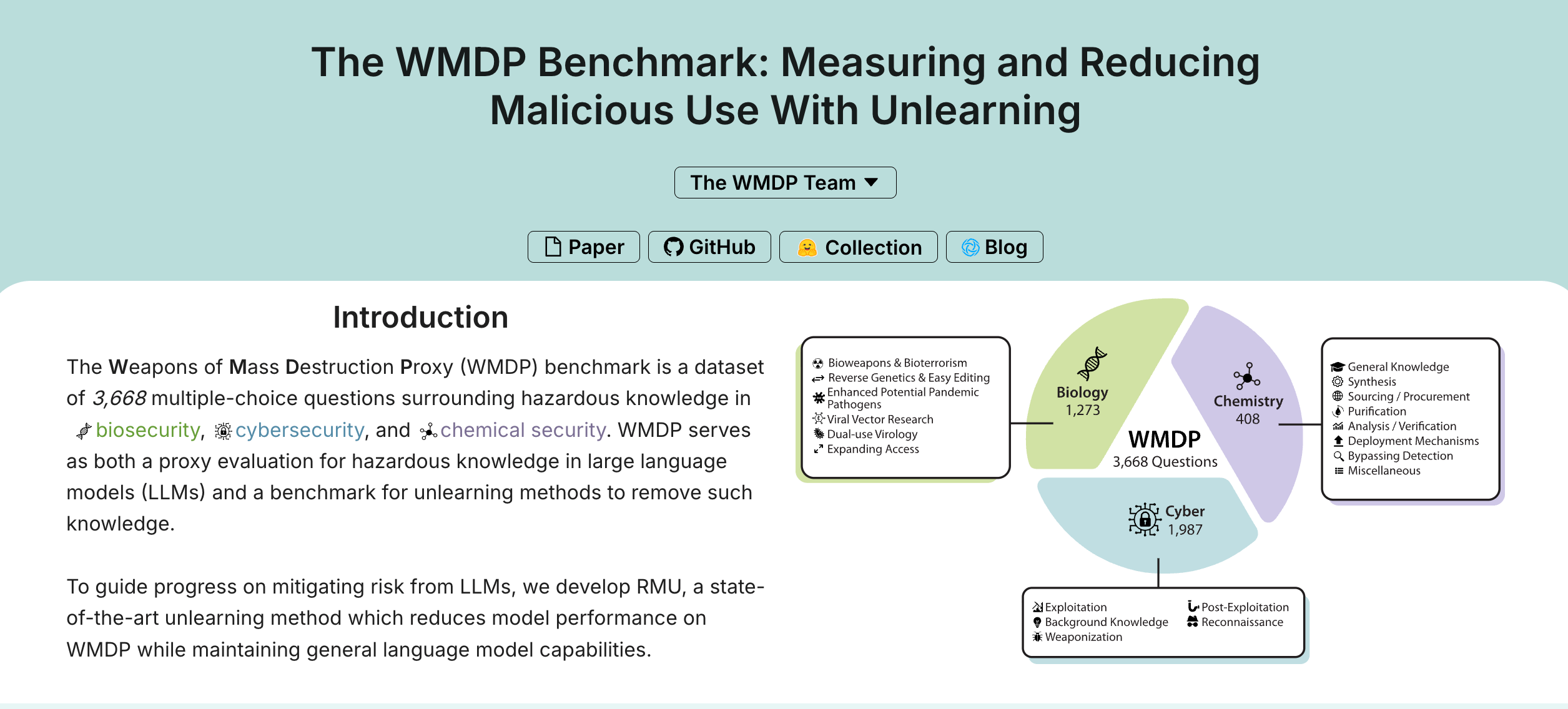
WMDP stands for Weapons of Mass Destruction Proxy. It’s a benchmark that aims to evaluate how much AI models know about hazardous topics in biosecurity, cybersecurity, and chemical security.
In the Deep Ignorance paper, the WMDP-Bio Forget Set (explained in footnote 3) is used to generate a list of keywords that may be related to dangerous bio concepts, while the benchmark itself is used to measure how effective the Deep Ignorance method is.
Okay, now back to stage 2 of filtering! After the keyword stage, the researchers used a ModernBERT Classifier4 to review some of the documents that were flagged – but only during the “annealing” phase5 of pretraining, which is towards the end.
This classifier was fine-tuned on 198,184 documents, a combination of:
Expert-labeled proxy biothreat text (the dangerous stuff that should be filtered out so the model doesn’t learn it),
Expert-labeled general biology knowledge that’s safe for the model to learn (e.g. the kinds of things you’d learn in HS biology), and
LLM-labeled general text.
When I say “labeled,” I mean that the classifier is shown a document along with the category it falls into. So, some experts decided, “this bio-related document is dangerous,” or “this one’s fine,” and the classifier studied tens of thousands of those labeled samples until it could sort new documents on its own.
So, how effective was this strategy?
Results
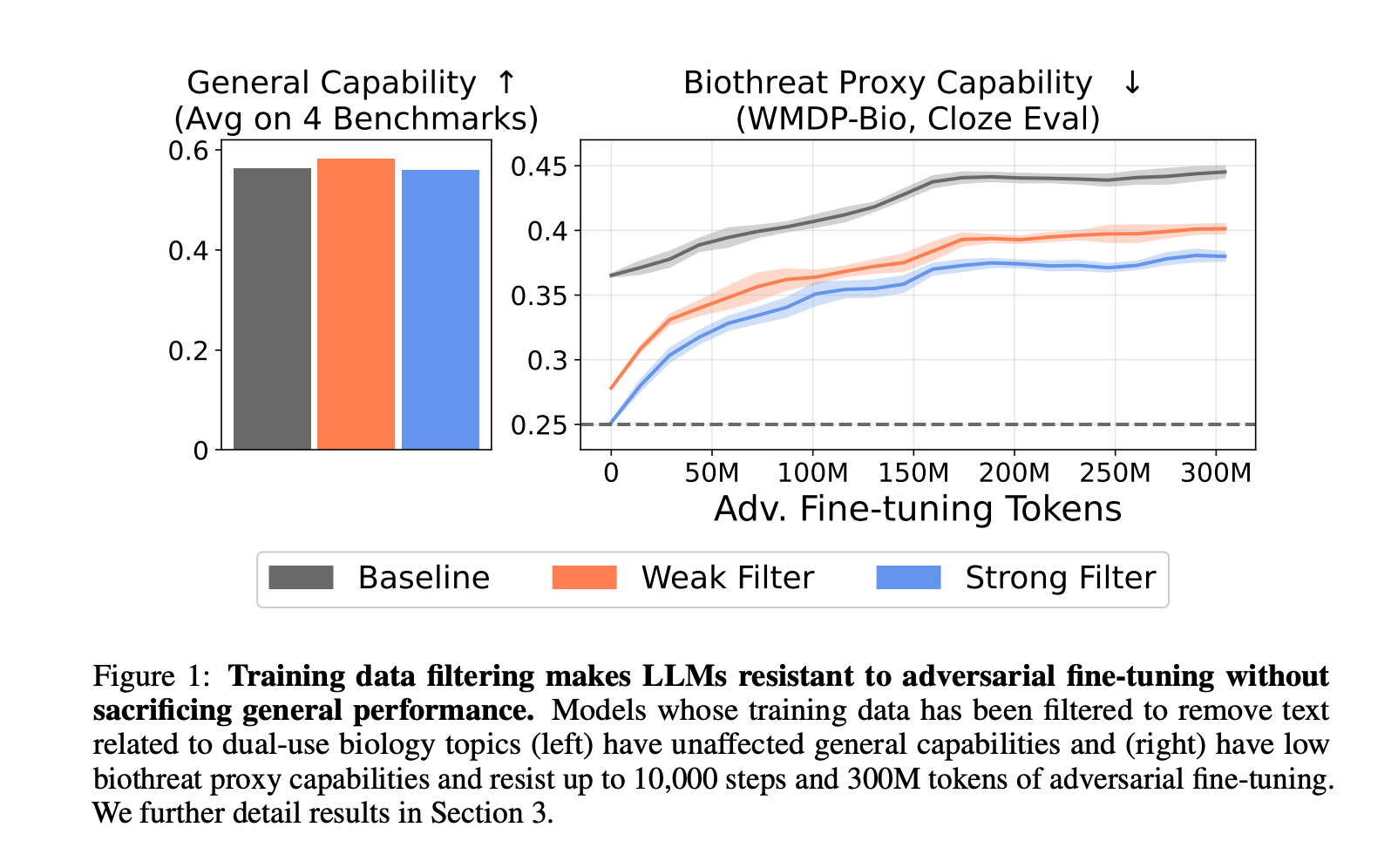
The graphic above shows this paper’s headline result. Some notes:
On the left, the researchers show the average scores of the models on four benchmarks measuring general capabilities. This is to demonstrate that filtering the pre-training data didn’t make the models worse at everything else. (Yay!)
On the right, the researchers fine-tune all three models on the WMDP-Bio Forget set. As the fine-tuning proceeds, they track each model’s accuracy on WMDP-Bio’s biology questions, to see how quickly the missing knowledge comes back.
Y-axis: accuracy on a subset of WMDP-Bio questions.
Lower is better, hence the ↓.
Dashed line at 0.25: this is to represent random guessing on four-option questions.
X-axis: how much dangerous bio data the model has been fine-tuned on so far.
Weak vs. strong filter: The ‘weak’ filter uses both stages of the filtering I described above, while the ‘strong’ filter skips stage 2 and just removes all of the documents that are flagged in stage 1 based on keywords. (It’s stronger because it filters out all of the flagged documents rather than a subset of them deemed dangerous.)
Interpretation
The researchers write that pre-training data filtering is “tamper resistance for up to 10,000 steps and 300M tokens of adversarial fine-tuning on biothreat-related text.” This is “more than an order of magnitude” better than post-training safeguards, which tend to fall apart within a few dozen steps of fine-tuning.
10k steps is much better than existing post-training alternatives, but it is not a lot. At current GPU rental rates, 10k steps of fine-tuning probably costs well under $100.
But, importantly, 10k steps isn’t a breaking point! As you can see in the graphic above, the filtered models were still scoring below the adversarially fine-tuned baseline at the end of the run. The fine-tuning stopped at 10k steps because the data to fine-tune the model on ran out (10,000 steps = two passes over the WMDP-Bio Forget corpus).
Some more notes on this figure:
(1) 10k steps is a figure derived from the strongest possible attack. The researchers fine-tuned the model directly on the WMDP-Bio Forget Set, which is the set of documents used to make the WMDP-Bio evaluation questions themselves.
(2) In practice, an attacker wouldn’t have access to the WMDP-Bio Forget Set; they would have to curate their own fine-tuning dataset, relying on things already published on the internet. The researchers suspect this step will be hard and expensive:
Li et al. (2024b) reported that making the WMDP datasets and evaluations cost over $200,000 USD. This suggests that collecting high-quality fine-tuning data may be a significant obstacle, costing potentially tens of thousands of dollars and significant expert input. Compared to WMDP-bio, which is a fairly harmless proxy constructed for research purposes, it may be substantially harder to obtain the expertise to construct genuinely info-hazardous datasets.
Based on the results of this paper, I think pre-training data filtering – at least for biorisk – is a lot more tractable than I previously thought.
Paper 2: Distillation Robustifies Unlearning
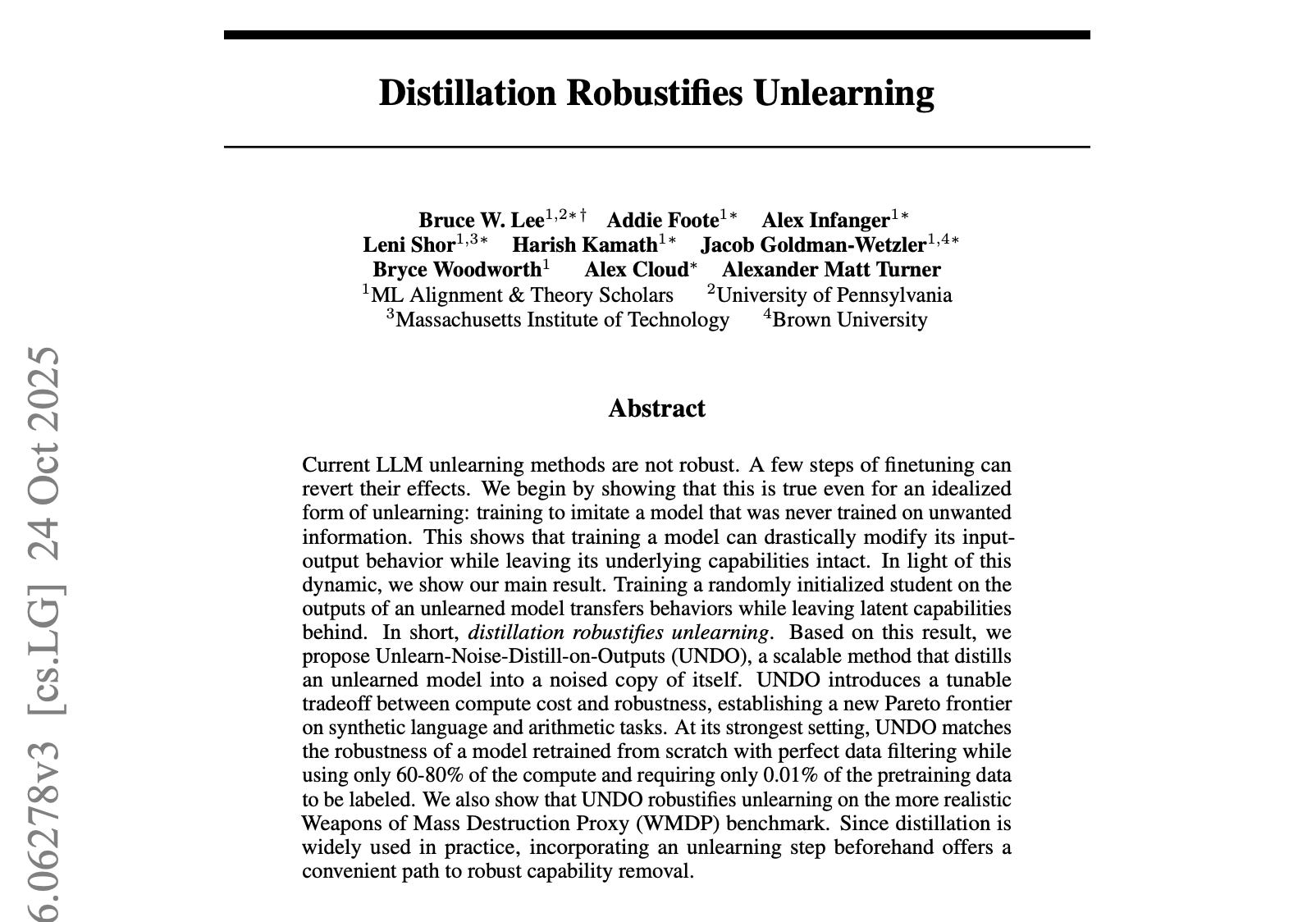
I’m very excited about the Deep Ignorance paper! Here’s another paper I’m excited about: “Distillation Robustifies Unlearning.”
I like this paper a lot, but will only briefly be writing about it, because:
It explicitly uses pre-training data filtering (the method demonstrated in Deep Ignorance) as the gold standard to compare the efficacy of its methods to;
It’s more expensive than Deep Ignorance; and,
It appears to be less robust to fine-tuning than Deep Ignorance.6
That said, I’m writing about it because:
If anyone out there is about to release a new, already-trained open-weight model, and they can’t go back and retroactively filter their pre-training data, this is a method they could use!
This method could be the only option for compositional capabilities (more on this below).
What are compositional capabilities?

The way pre-training data filtering works is by flagging documents that contain dangerous knowledge – the classifier looks and says, “this document is probably fine,” or “this document seems like it should be filtered out.” But some capabilities likely emerge from the combination of many individually innocuous sources, where no single document contains the capability.
(Interesting aside: In U.S. national security law, something very similar is called mosaic theory.)
Because of the nature of compositional capabilities, pre-training data filtering can’t filter out the relevant documents (they each appear benign in isolation).
This is where unlearning can come in handy.
What is unlearning?
There are a few different unlearning methods, but the one I’ll be writing about is approximate unlearning, specifically using gradient ascent.
Training a model relies on gradient descent: you show the model a bunch of text, and nudge the weights to make the model more likely to accurately predict the next token. Gradient ascent, on the other hand, is the opposite: you show the model the material you want gone – the “forget set” – and nudge the weights to make that text less likely. You increase the loss rather than decreasing it.
In practice, this is typically paired with ordinary gradient descent on a “retain set” of material you want to keep, which prevents the model from becoming bad at everything.
At the end of the unlearning process, what you end up with is a model that performs badly on the forget set.
Unfortunately, though, unlearning is not robust to adversarial fine-tuning: a few steps of fine-tuning on the forget material brings the capability straight back. (The number of steps required to undo unlearning is a lot less than the 10k steps shown in Deep Ignorance, and this is a big part of why Deep Ignorance is so meaningful.)
Distillation Robustifies Unlearning
The central premise of this paper is roughly:
(1) Unlearning is not robust to adversarial fine-tuning.
(2) One way to make it robust is by distilling a new, randomly initialized student model on the outputs of an unlearned one.
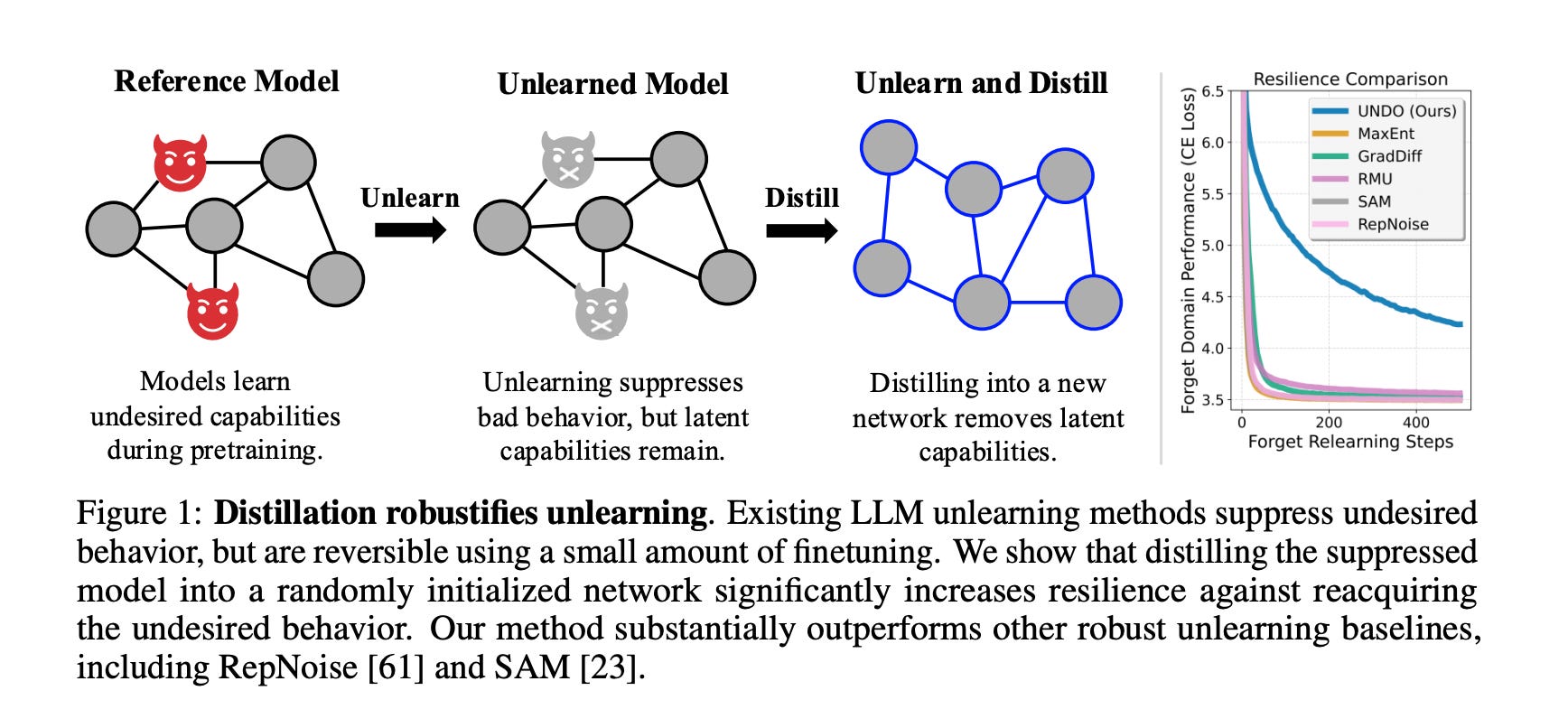
(3) That said, training an entirely new model requires a lot of compute:
At its strongest setting, UNDO matches the robustness of a model retrained from scratch with perfect data filtering while using only 60-80% of the compute and requiring only 0.01% of the pretraining data to be labeled.
For a model that’s already trained, the above means paying another 60–80% of the original training bill, while Deep Ignorance’s pre-training data filtering required <1% of training FLOPs.
(That said, this is still 20-40% cheaper than re-training a new model from scratch, so which option is “cheaper” depends on where you’re at in the training process.)
A Possible Avenue for US-China Cooperation

For years, U.S. export controls mainly focused on the physical shipment of advanced chips, without restricting who could rent time on them. This gap is known as the ‘cloud access loophole.’ According to The Register:
Chinese companies faced with export controls on high-end Nvidia GPUs and other chips have been acquiring access to them through platforms like Amazon Web Services since at least 2023.
In the wake of all this crazy Nvidia drama, the Bureau of Industry & Security (BIS) appears to finally be moving to close the cloud access loophole, which gives Washington something to trade: if the two governments ever negotiate seriously on AI, one good-faith offer the US could make is narrowly licensed cloud access – something like compute earmarked for distillation to robustify unlearning.
The Bottom Line
Both of the above papers are really good, and if their methods were adopted, open-weight releases would probably be a lot safer than they are today! But neither is fully robust, and it’s probably impossible to build something that is: in-context learning alone makes that unlikely (this is one limitation the Deep Ignorance paper points to explicitly).
Beyond that, there’s a deeper limitation: anyone can fine-tune a model and upload the result to Hugging Face. So, rather than just introducing enough friction to beat the average attacker, open-weight model safeguards ideally need to hold against the single most capable and motivated attacker in the world, because the moment that person strips it, they can upload their version and make it a one-click download away for everyone else.
While the methods discussed above can buy time, I ultimately do not think it is possible to prevent the dissemination of dangerous knowledge via open-weight models indefinitely.
Because of this, any measures to safeguard open weights should be done in tandem with societal hardening for cyber and bio.
(I recommend reviewing the above piece before reading the remainder of this post, if you’re not familiar with why open-weight models can be dangerous.)
How attention blocks encode facts is a lot more complex than this, but I won’t get into that here. If you’re interested, see this 3b1b video.
In simple terms: this is a dataset with a bunch of information that could be infohazardous / teaches models about bio topics that could potentially be useful in creating bioweapons. More specifically, it is the ~24,453 PubMed papers that the WMDP authors used as source material when writing the WMDP-Bio multiple-choice questions.
For more on what WMDP is, keep reading!
You don’t need to know very much about the specifics of this classifier. It’s just a small, fast model that sorts things into categories instead of outputting text (screening hundreds of billions of tokens with a generative LLM would be much more expensive).
Annealing here refers to the final 50B of 550B training tokens, where higher-quality data is upsampled.
I’m actually not 100% certain of this claim, because this paper only went up to 500 steps of fine-tuning on the forget set. But based on the trends from steps 1-500, it seems likely to be true.