

Thank you to Roman at Constellation for reminding me that I had a draft on this, and Denis for the comment that inspired it!

AI safety has a problem. As I wrote about in my previous post, we’re very talent constrained:
Currently, there are roughly 1,100 to a few thousand people working on existential risks from AI. For comparison, 80,000 Hours writes that “[the] Nature Conservancy alone has 3,000–4,000 employees… the World Health Organisation [also] employs over 8,000 people.”
At the same time, I’ve heard countless stories of mid-career professionals wanting to break into the space and struggling to do so. What gives?
This post argues three things:
AI safety should proactively recruit mid-career professionals (hereafter MCPs).
Our main on-ramps, fellowships built for entry-level talent, fail them.
A workshop → grant → founder-matching pipeline would be a good start.
Why should we target mid-career professionals?
Mid-career professionals have valuable skills and years of experience. They just need to be upskilled on the AI safety component, which I believe could be done to a reasonable degree with maybe a week’s worth of reading and a weekend-long workshop.
With a proven body of work to judge, we don’t have to wait for applications – we can spot the people we want and recruit them directly, with high confidence they’ll be good.
MCPs are uniquely positioned to fill the roles AI safety needs most – comms, ops, management (see: AI safety is bottlenecked on generalists) – because they have years of experience doing exactly these jobs.
Why current on-ramps fail
Fellowships are the main on-ramp, and they’re optimized for entry-level talent for a reason – it’s a bit unreasonable to ask someone established to quit their job, take a massive pay cut, and join a weird three-month thing with no guarantee of a stable job on the other side.
I like BlueDot’s Career Transition Grants, but they’re most effective when paired with something that gets people involved in the space in the first place.
We can’t just wait for MCPs to stumble on a Rob Miles video, decide to upend their years-long careers, and apply for a career transition grant! The grant funds the transition; something else has to spark it.
Currently, the closest thing to an on-ramp designed specifically for MCPs is maybe Lateral Workshop, but as far as I know, it’s never run before and may never run again. As a result, I don’t know very much about it, but I’m excited about its premise.
In the future, if it does run again, I think it should try actively headhunting promising MCP talent rather than waiting on applicants.
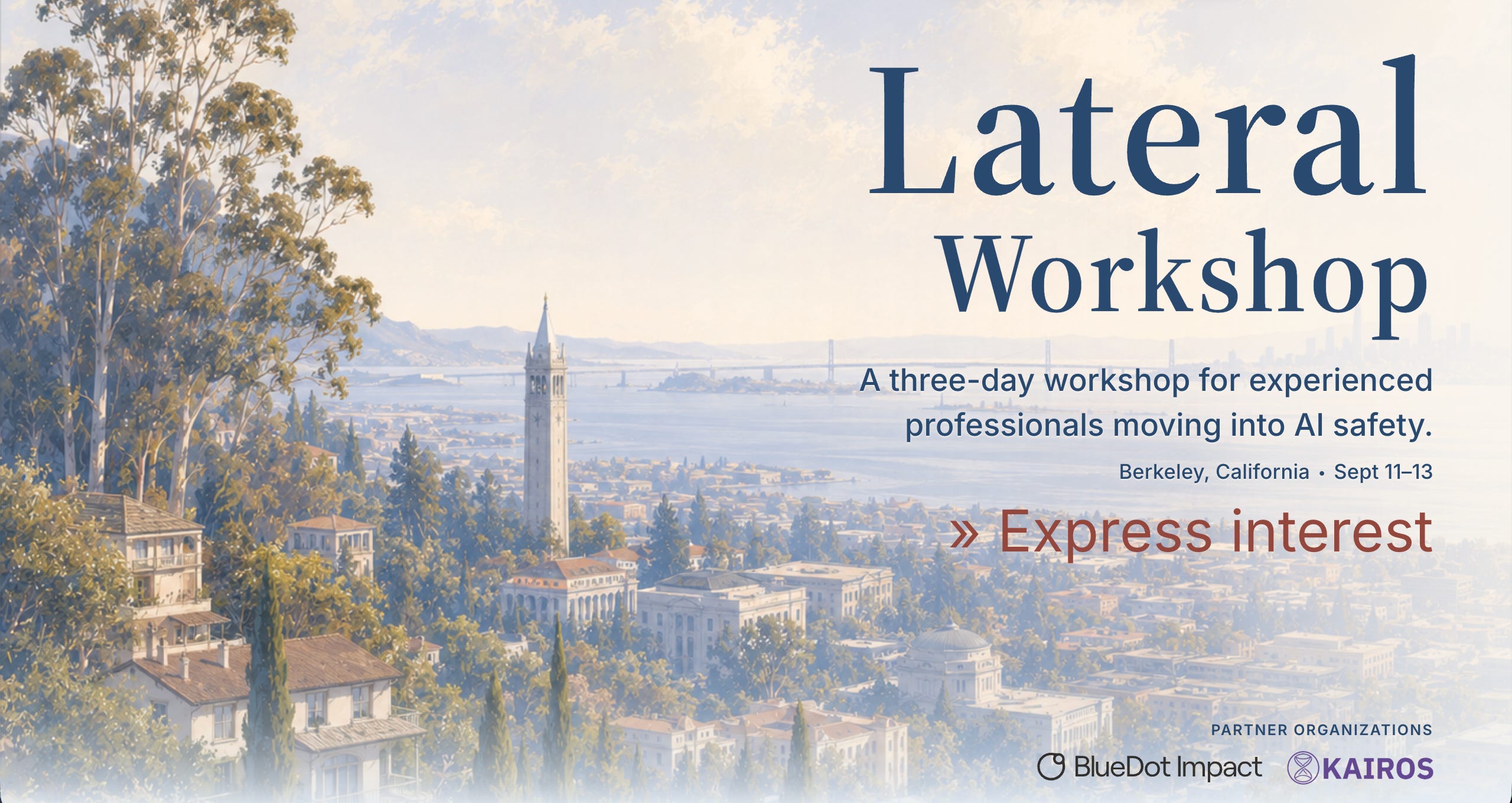
What I am bullish on: A new founder pipeline for mid-career professionals

Here’s an on-ramp that I think might work:
Step one: more Praxis-like events.
Praxis, organized by Chanden Climaco (Generator Residency) and Saul Munn, took champion debaters and acquainted them with AI safety. There was no application process – the organizers reached out to talented debaters in their networks (both having debated in high school) and invited them directly. Attendees got some amount of pre-reading (AI 2027, among other things), then two days of talks and discussions with speakers from the field. And now, Chanden, Saul, and others are hand-holding interested participants through application processes and pointing them at specific ways into the field.
This is exactly the strategy I’m bullish on! Headhunt by track record, spark with a short intensive, then guide the transition.
Can we do this for mathematicians? Physicists? Comms professionals?
Step two: BlueDot career transition grants (or CG transition grants) for the workshop participants who decide to pivot.
The workshop sparks the transition; the grant funds it, and (perhaps more importantly) it’s also a signal: there is a place for you here, and people willing to back you. Remember who we’re asking – people succeeding in high-paying careers, being told to trade certainty for a weird niche field they learned about at a weekend workshop. That’s a big ask. Every ounce of friction and doubt you can remove matters.
Step three: founder matching and high-level hiring coordination. We’ll try to pair you, a strong executor, with a team of aligned advisors or an aligned cofounder to execute on a vision (see my piece on optimizing the grantmaking process by separating strategic taste and execution ability)
(Another thing that we could do for MCPs: reverse headhunting, as I’ve proposed for fellowships)
Design notes from me
The goal of these workshops is simple: participants should leave wanting to join the field. Everything else is downstream of that, which has two implications:
Cover the field wide, not deep. Structure the program around several sub-areas – loss of control, misuse, AI-enabled biorisk, AI economics – because different things convince different people.
If a participant doesn’t care about technical alignment and the whole workshop is about technical alignment, they leave as someone who doesn’t care about the field. Give them one talk on alignment and one on biorisk, and they might leave a bit freaked out about smallpox!
Skip minutiae, e.g. the camps. It’s tempting to brief participants on the field’s internal debates – who believes what, which disagreements influence different approaches. Resist it. A participant who leaves motivated will go learn the camps on their own; the nuance about the field can all come later.
Final note
There has never been a better time for this. After the Hugging Face hack, more people are interested in AI safety than ever before. We need to be able to receive them.

Edit to add more resources for MCPs (h/t Robyn from the MATS Slack):
High Impact Professionals’ Impact Accelerator: “A free 6-week virtual program that helps experienced professionals transition into high-impact careers.”
Successif.org: “Free, expert-guided career development for experienced professionals.”
If you’d like to be connected to the Praxis team, reach out and I can connect you! Alternatively, you can find their contact info at the bottom of their website. They’re keen to chat with funders and grantmakers to discuss scaling this approach.
But do the positions exist? The linked comment from Denis tells a story of a highly qualified MCP spending years unable to get hired.
Perhaps somewhat predictably I strongly agree with this post! Thank you for writing it!