

Update 10/6: After a great chat with a friend, have added an analogy re: the Colombia-Venezuela border conflict to this post!
The structure of this post is roughly:
I think AI safety is approaching the comms talent bottleneck suboptimally; and,
I think this generalizes to a broader point about the field, which is that we aren’t outsourcing enough work.
(Read my earlier post about how AI safety needs a moonshot comms initiative here.)
AI safety is approaching the comms talent bottleneck suboptimally
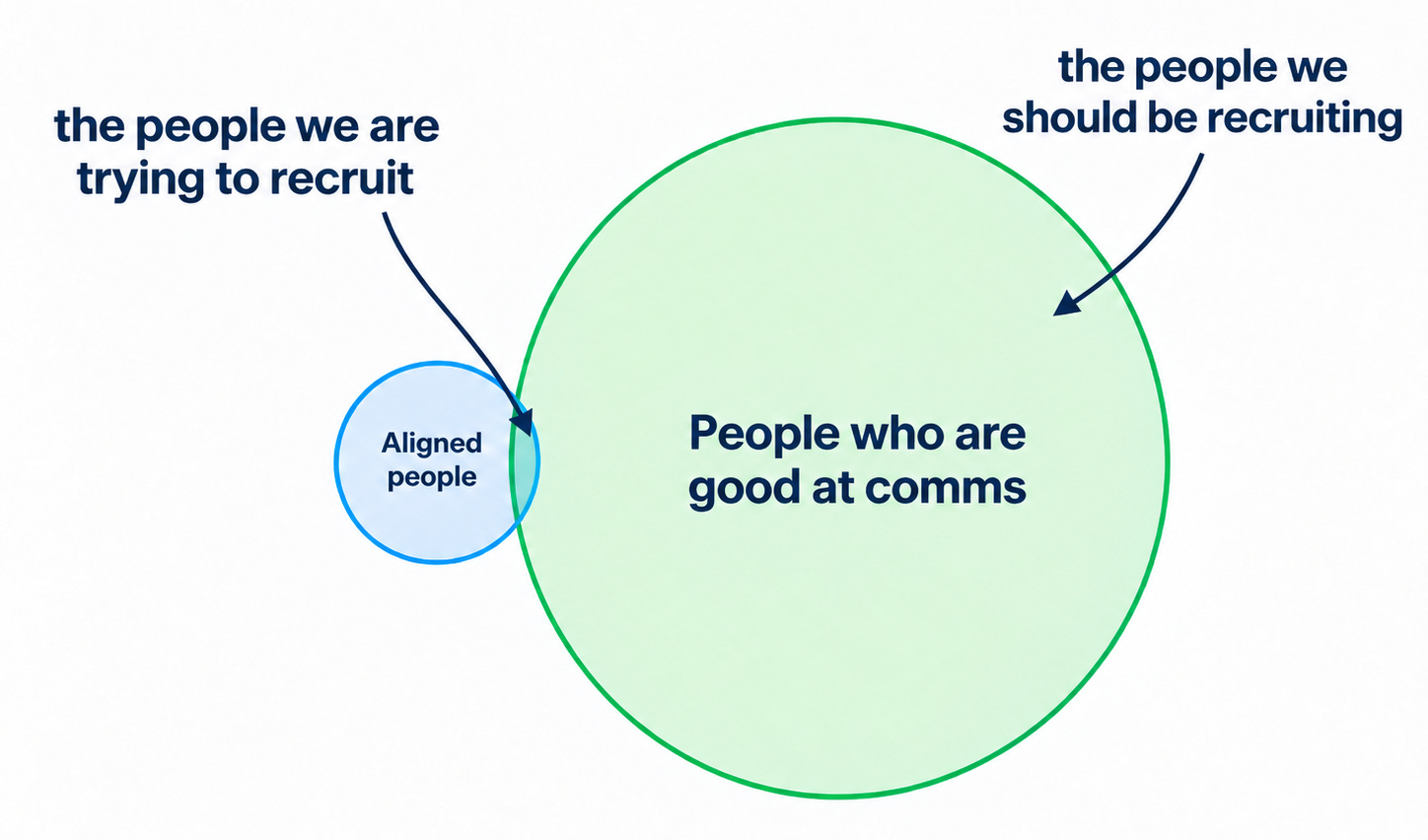
AI safety has a comms talent problem: there are very, very few people who are (1) good at comms, and (2) aligned.
The (unfortunately very limited!) efforts to solve this problem, up to this point, have included:
An AI Safety Comms Fellowship, to teach undergrads interested in AI safety how to become better at comms.
(The fellowship is supposed to select for undergrads who are good at comms, but my understanding is that this has been pretty hard, and that the mentors they’re recruiting are intended to teach them how to be better.)
The Frame Fellowship, which takes people who are good at comms and tries to get them to make content on AI safety.
Their website says they select for people with “communication ability and a genuine drive to engage with the subject [of AI safety].”
So, we have an effort that’s trying to take aligned people and make them better at comms, and then we have an effort that’s trying to take people who are good at comms and make them more aligned.
To be clear, I think these initiatives are steps in the right direction, and I’m glad that the people running them are working on this hugely important problem! Not many people are right now. But I don’t think we have enough time to train up undergrads to be good at comms, and I also don’t think we need good comms people to be aligned as a prerequisite for having them work on AI safety.
A helpful analogy
Perhaps a useful analogy here is something like: if I wanted to create a documentary about the Colombia-Venezuela border conflict, the thing that I would not do is to:
(A) Try to find people who care a lot about the Columbia-Venezuelan border conflict and then make them good at comms, or
(B) Find people who are good at comms, and then make them care about the Colombia-Venezuela border conflict as a prerequisite for them working on this project with me.
Instead, I would just look for people who are good at making documentaries, and hire them!
What do I think we should do instead?
A model that I think might work

Hire a bunch of people who are good at comms: scriptwriters, videographers, directors, actors (for being on-camera and/or for doing voiceovers), editors, social media managers, graphic designers, etc. Select only for people who are good at what they do.
Assemble a team of these people, and pair these teams with one or two “aligned” people each to be “Creative Directors.” These people’s jobs would include, roughly:
Coming up with ideas for content that should be made.
Reviewing scripts + storyboards around said ideas, prepared by the team.
~Nothing else.
The skills that Creative Directors would need to have:
A good sense of what topics would be best to make content on
Good comms taste (e.g., I can look at this script and tell whether or not it seems good / bad)
My hypothesis is that Creative Directors would not actually need to spend that much time on this role, and that this could even be a part-time engagement! But I could be wrong (this could be planning fallacy).
I directionally covered this idea in a previous piece, written for Dwarkesh’s essay contest. I argue in that essay that the reason why it’s hard to spend a lot of money in AI safety is because we are a small and new field, and we’re bottlenecked on founders and grantmakers; we don’t have enough orgs or people to productively be able to absorb all of CG’s money on timescales that matter.
The solution I propose is to channel a lot of money into the already-established fields of (1) mass media, and (2) political infrastructure:
But two categories of spending can absorb billions immediately, because the infrastructure to deploy that capital already exists outside the field…
[W]e can convert existing ambient support into concrete political pressure, and fast, because it doesn’t require building a whole new field. Instead, it requires investing in mainstream media production, advertising, and electoral campaigns– industries that already know how to reach hundreds of millions of people. A blockbuster film like the Barbie Movie costs $200–300 million to produce and market. Obama’s 2012 reelection campaign spent $1.1 billion. A Super Bowl ad costs $10M for 30 seconds.

Some notes on broader comms strategy
My sense is that there are currently a lot of small, fragmented efforts at making content (various YouTube channels, for example), and that the above proposal does not actually get at the bigger-picture problem, which is that AI safety as a field doesn’t really seem to have a broader comms strategy.
What are the bigger-picture messages we need people to hear? How do we get people to substantively engage with the content people create? Who’s doing the high-level thinking about what outreach initiatives should be run, and where? (I’ve written previously about AIPN’s message-testing, which I think is really helpful here.)
An argument I’ve heard on the above: more important than getting another team of people to create more content, then, is for the field to figure out this macro-strategic approach.
I think this is true! However, I think a big reason why we don’t have better high-level strategy in comms is because we don’t have enough talent working on it; all we have right now is many small, fragmented efforts spread around various places.
In other words: I think the strategy problem is, at least in part, downstream of the talent problem.
On outsourcing
More generally, I think there are a lot of things AI safetyists could outsource to non-aligned people.
For example, I recently saw a post on the MATS slack that was trying to recruit people to work on translating AI safety research / reports from English to other languages. To be clear, the people working on this are great! But this seems to fall pretty clearly in the category of thing that, to me, seems obvious we should just hire non-AI-safetyists to do!
Other things that I suspect can be outsourced similarly:
Logistics for event planning (e.g. coordinating people’s flights and reimbursements, finding venues, catering stuff, etc)
Some executive assistant roles (that don’t involve dealing with sensitive information)
Lots of ops-related tasks:1
Finance: bookkeeping, payroll, reimbursements, other tax-related things.
HR admin: contracts and benefits, visa + immigration paperwork stuff.
Various random things: website design, Airtable help, database cleanup, office management, etc.
The bottom line
We do not have all the time in the world. Competent + aligned people are in extremely short supply. But not everyone who works on AI safety needs to be aligned! The field should be more intentional about who works on what.
Thanks to Andrew Wei, Girish Gupta, Noah Birnbaum, and Aiden Kim for very helpful discussion, feedback, and disagreement! :)
There is an argument to be made that working with aligned people is easier, which may be why a lot of ops people at various orgs are surprisingly aligned. I think this is true, but the bar should be lower for comms in particular, because we don’t have enough aligned comms people to draw from. (I also think that orgs who are struggling to hire for ops roles should not be so strict on hiring for alignment, and that there is a counterfactual impact case to be made that the most aligned + competent people should be in other roles, depending on the delta.)
i agree with most of this! in particular, areas like translation seem to be easily outsource-able, with just 1-2 people native speakers with medium to high AIS context that can verify the connotation of writing.
however, when it comes to more ambitious comms projects like creating videos and explainers, i'm much more skeptical on how much we can outsource.
i definitely don't think we need to have our video editors and cinematographers be AI safety people, but as a university organizer, a lot of the work / frustration has to deal with creating really good presentations and ways to communicate AI safety concepts in ways that are legible, accurate, and purposeful.
i suspect that 1-2 "Creative Directors" will either be a) insufficient or b) those people will have a ton of work to do, since creating storyboards and narratives is very challenging!
so, i think having high-context people working in comms that can think strategically about how to best present ideas is still very, very valuable and a bottleneck